Thursday, 6 September 2007

Alien Topography and Prophetic Misdirection

It's one of the all-time classics. I even scrutinized it in film studies (primarily focusing on the subliminal content).
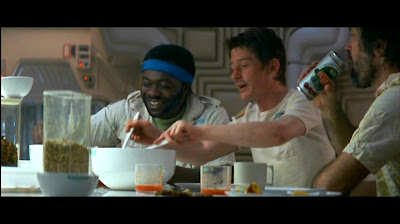
Fancy taking a look at the chest-bursting scene with me? We'll have a look at how the scene is edited to achieve maximum emotional impact. And I've taken screen grabs to provide you with a visual representation of the emotional topography. (Just compare image one to image three and you'll understand what I mean :o)

- WARNING: GORY IMAGE BELOW -


KANE: First thing I'm going to do when we get back is eat some decent food.

Here, the emotional topography registers: HAPPY.
The crew are laughing and joking.

The horror genre knows well the art of misdirection.
The viewer is invited to believe that recent grim events are in the past, and the future looks rosy. Kane's expectation for a good meal on his return to Earth is a form of prophetic misdirection. We've looked at this quite a bit. The technique is used an awful lot in movies and literature. This technique was key to my two short stories, and I use it liberally in my novels.
At this point, the scene is building a sense of security, piling on the familiar, surrounding us with friends, titillating our tastebuds, inviting us to feel good about life and about the future.
Why?
Because the higher you climb, the further you fall.
And this is contrast.
Compare the effects of holding a dark grey sheet of card up against a black sheet with the effects of holding a white sheet of card up against a black sheet.
Sure, there are times when we want a subtle topography. But I daresay that the audience will remember us more for our ability to create maximum emotional impact through maximum contrast.
Build up; destroy.
So, ready to be destroyed ..?


Now the emotional topography registers: SHOCK.
We get shock from black on white. (Consider, too, the idea of a reveal defined by knowledge and ignorance.)
If Kane had been complaining of chest pains from the moment he awoke, the shock would have been diluted, even nullified.
Instead, the chest pains are introduced only once he is very happy and imagining a future with good food, and only as a very brief precursor to the alien's entrance.


We've also discussed at some length the concept of rapidly switching focus as a means of instilling discomfort and confusion; of removing those crutches that provide the audience with stability, and leaving them to flounder and totter on quivering legs.
This frame is the visual epitome of this concept. What a brilliant moment!
Here, the emotional topography registers: CONFUSION (or What the f***?).
It is the crew's reaction to the event. Chaos, panic, all crutches and focus are removed. Check out the removal of bonding as the crew members have gone from sharing a meal and a laugh to looking in different directions, moving in different ways. Fantastic.

There's an interesting paragraph on editing techniques on wikipedia.

All images copyrighted.
Alien script here.

Wednesday, 5 September 2007

Giant Clank


Peer Gynt


One hundred years ago yesterday, Edvard Grieg died.
He's probably best known for his Piano Concerto in A minor, and for his musical score for Ibsen's Peer Gynt. And, as many of you folks know, I have a special fondess for that wonderful creation that arose from the combined genius of Ibsen (words), Grieg (music) and Munch (yes, he of The Scream, who designed the posters!). Can you imagine the thrill of such a potent force!

I saw Simon Callow as the eponymous anti-hero in a production of Peer Gynt about nine years back. It was tremendous, and was the inspiration for my pen-name (the variably spelt Solvejg/Solveig [in the guide, the spelling was with the 'j']).

By all accounts, neither Ibsen nor Grieg were happy with the results of their collaboration.
In a letter to his friend Frants Beyer, Grieg wrote:
And then I have produced something for the "Hall of the mountain king", which I literally cannot stand to listen to, it rings so of cow dung, of Norwegian-Norwegian-ness, and to thyself be enough-ness! [Source here.]
Ibsen himself had much to say about Grieg's interpretation of Morning Mood. Indeed, for many, the piece has come to evoke images of rolling, green hills and corpulent trees, whereas it was intended to evoke the atmosphere of a palm grove on the coast of Morocco.

I'd like to share this transcript of the letter that started it all: it is the letter that Ibsen wrote to Grieg, inviting him to collaborate on Peer Gynt. You can read more on Ibsen.net. It gives me goosebumps each time I read it.

- - -

Dear Mr. Grieg,

My object in writing to you is to ask if you would care to co-operate with me in a certain undertaking.
I am thinking of adapting Peer Gynt - of which the third printing is soon to appear - for the stage. Will you compose the music that will be required? Let me indicate briefly how I think of arranging the play.
The first act is to be retained in full, with only a few cuts in the dialogue. Peer Gynt´s monologue [scene 2] I wish to have treated either as melodrama or in part as recitative. The wedding scene [scene 3] must be built up by means of a ballet into something more than is in the book. For this a special dance melody will have to be composed, which would be continued softly to the end of the act.
In the second act, the musical treatment of the scene with the three cowherd girls [scene 3] must be left to the discretion of the composer - but there must be lots of deviltry in it! The monologue [in scene 4] should, I think, be accompanied by chords, in melodramatic style, as also the scene between Peer and the Woman in Green [scene 5]. There must also be some kind of musical accompaniment to the scene in the Hall of the Mountain King; here, however, the speeches are to be considerably shortened. The scene with the Boyg, which is to be given in full, must also be accompanied by music. The Bird Cries are to be sung; the bell ringing and the psalm singing should be heard in the distance.
In the third act I need chords, but not many, for the scene between Peer, the Woman, and the Ugly Brat [scene 3], and I imagine that a soft accompaniment would be appropriate [for Aase´s death].
Almost the whole of the fourth act will be omitted in performance. In place of it I think there should be a large-scale musical tone picture, suggesting Peer Gynt´s wandering all over the world. American, English, and French airs might be used as alternating themes, swelling and fading. The chorus of Anitra and the Girls [scene 6] should be heard behind the curtain, jointly with the orchestra. During this music, the curtain will be raised, and the audience will see, like a distant dream picture, Solveig, now a middle-aged woman, sitting in the sunshine singing outside her house [scene 10]. After her song, the curtain will be slowly lowered again while the music continues, but changing into a suggestion of the storm at sea with which the fifth act opens.
The fifth act, which in performance will be called the fourth act or the epilogue, must be considerably shortened. A musical accompaniment is needed [for the scene with the Stranger]. The scenes on the capsized boat and in the churchyard will be omitted. [At the end of scene 5] Solveig will sing, with the music continuing afterward to accompany Peer Gynt´s speeches and changing into that required for the choruses [in scene 6]. The scenes with the Button-molder and the Old Man of the Dovre will be shortened. [At the end of scene 10] the people on their way to church will sing on the path through the forest. Then bell ringing and distant psalm singing should be suggested by the music that follows and continues until Solveig´s song ends the play. And while the curtain is falling, the psalm singing will be heard again, nearer and louder.
That is approximately the way I have imagined it. Will you let me know if you are willing to undertake the job? If I receive a favorable answer from you, I shall at once write to the management of the Christiania Theater, sending along the revised and abridged text, and making certain, before we go any further, that the play will be performed. I intend to ask 400 specie-dollars for it, to be divided equally between us. I am certain that we may also count upon the play being produced in Copenhagen and Stockholm. But I shall be obliged if you will keep the matter a secret for the present. May I please hear from you as soon as possible.

Friday, 31 August 2007

Queue 2

Okay, hands up, it's a fair cop guv'nor: I watched EastEnders this evening.
Been thinking long and pericardially about the previous post. Have some tenuous conclusions which need refining, but for now here's an absolutely superb scene from EastEnders. Crumbs, that just sounds so wrong. I might get some character names muddled, and I might just invent some if I get stuck. If you're waiting for Sunday's Omnibus extravaganza, I offer you a spoiler alert, and my sympathy.

Phil Daniels has gotten hold of a stolen security videotape. It's wound to the end. Kind of like a cross between Memento and Quadrophenia. He's astonished to discover that the videotape has captured Patrick's attack - there is poor Patrick lying in his brains and blood. Well, not brains. So Phil Daniels starts to rewind the tape. Events unfold in reverse as we move back in time towards the attack and, presumably, a clear picture of the attacker. Ooh, now that's good suspense.
Meanwhile, Lucy sneaks out the house to go meet her boyfriend. I don't know if we were told that she was off to meet her boyfriend or if I just guessed that. See I was only half-watching and perked up when I saw this scene developing.
Phil Daniels rewinds a little further and Lucy arrives at her rendezvous.
Then we see the attacker. Then we see that Lucy has met with her boyfriend - the attacker!

So we can see that the reveal is left right until the end. Which is a parallel to option TWO in the previous post.
BUT
We also have the suspense in the shape of the rewinding of the tape. Rather like option ONE where the reader is darned sure that the couple are heading into trouble.

So, to get the most out of the car crash/you're having an affair scene, we would keep the reveal to the end, AND ensure that the speeding is given lethal intent from the start. Therefore, it should open with a line that clearly attaches suspense to the speeding without giving away the driver's knowledge of the affair. The new opening might read thus:

Bill ran the red light, tyres screeching as he attacked the bend. It was time to end it all.

The anticipation strand is obvious in both the car crash scene and in the EastEnders scene.
What is perhaps less obvious is the effect of holding the reveal 'til the last possible moment.
You can ponder upon that and I'll return very soon.